On November 3, Florida voters decide Amendment 3. Most coverage frames it as a homeowner tax cut. It is better understood as a change to how Florida’s local property tax system distributes its burden, and every property owner and tenant sits somewhere in that system.
The same vote looks different depending on whose balance sheet you are reading. A homesteaded retiree in Lakewood Ranch, an investor holding a strip center in Brandon, and a medical practice leasing space in Sarasota are all affected. They are just not affected the same way.
This post walks through the amendment from all three positions: homeowners, commercial real estate investors, and commercial users who lease the space they operate in. It is not a voting recommendation. It is a framework for reading the decision clearly.
The mechanics in brief
Amendment 3 pulls two levers at once. One reduces taxable value for homesteaded homes. The other slows how fast taxable value can grow on everything else.
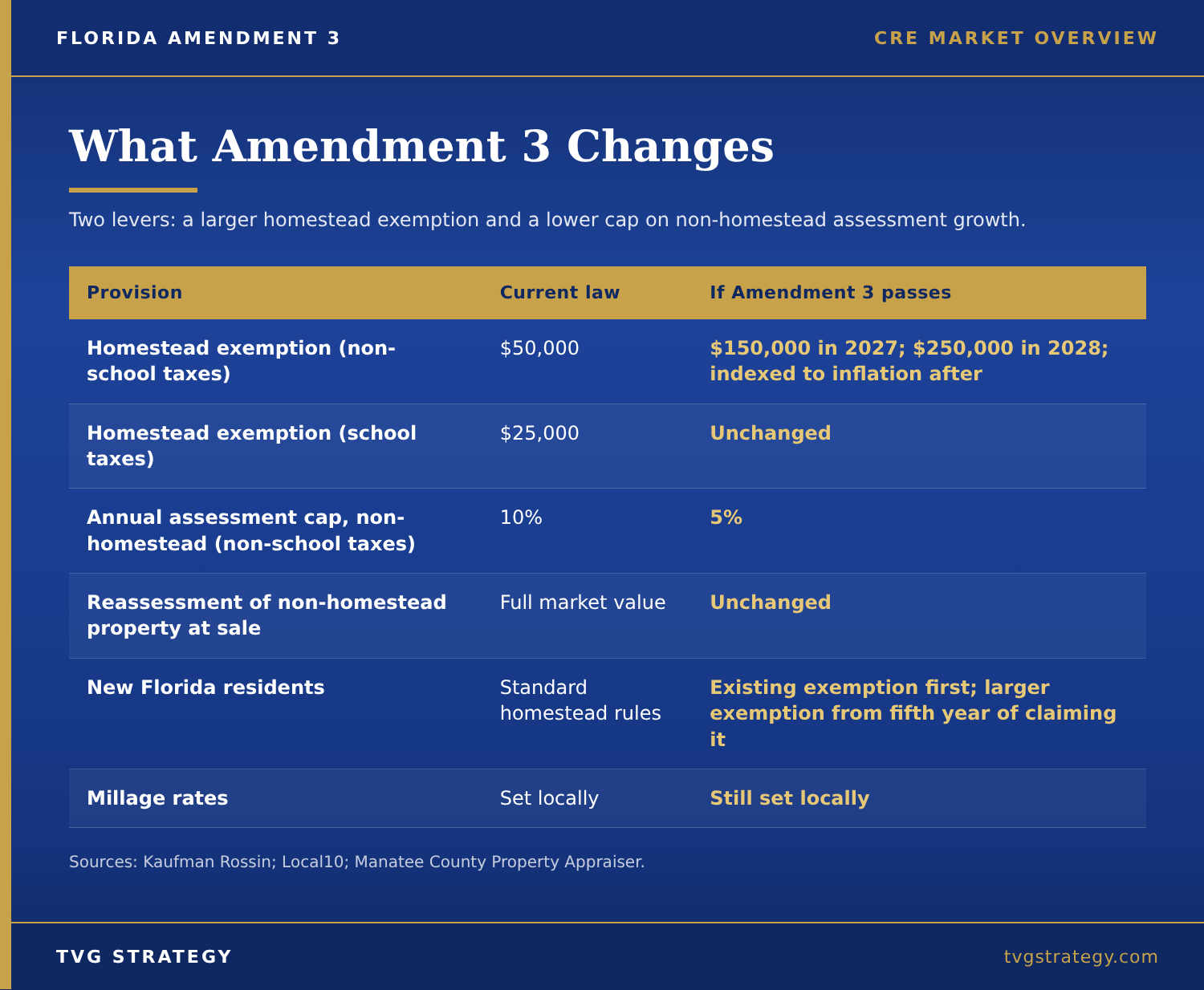
Table comparing current Florida property tax law with Amendment 3.
The Legislature placed it on the ballot as CS/HJR 1F after a June 2026 special session. It needs at least 60% voter approval. In August, a Leon County circuit judge ruled the original ballot title and summary misleading, and the Attorney General issued rewritten language. The policy did not change; only the description voters see did. (Kaufman Rossin, Local10)
Timing matters. November 2026 tax bills are not affected either way, because Florida collects property taxes in arrears. If approved, changes first appear on November 2027 bills. (Hillsborough County Tax Collector, Manatee County Property Appraiser)
The single most important fact for all three audiences: the amendment changes taxable values. It does not touch millage rates. Every outcome below flows from that distinction.
Perspective 1: Homeowners
Established homesteaded owners would receive the amendment’s most direct and readily quantifiable benefit: a larger exemption from non-school property taxes. Up to $200,000 more of a home’s assessed value would be shielded from county, city and special district taxes by 2028.
Three nuances matter more than the headline number.
A lower taxable value is not a guaranteed lower bill. Local property appraisers have stressed that the amendment reduces taxable value for homesteaded property but does not guarantee a homeowner’s final bill falls (CBS12). If local governments raise millage or add fees to cover lost revenue, part of the savings can come back in a different form.
School taxes stay as they are. The school-tax exemption remains $25,000. That portion of the bill is untouched.
Newcomers wait. Someone who moves to Florida after this year receives the existing exemption first and the larger one only from their fifth year of claiming it (Local10). For a market like ours, built on in-migration, that creates two classes of homesteaded neighbors on the same street.
Homeowners should also watch what replaces the revenue. County officials have floated options such as paid beach parking, park user fees and expanded red-light camera enforcement (CBS12). Those costs are paid regardless of homestead status.
The question for homeowners: how much of the exemption survives local budget responses, and what does the household pay through other channels?
Perspective 2: Commercial real estate investors
For commercial real estate investors, the amendment would reduce the maximum annual growth in assessed value, while leaving future millage rates and other local revenue decisions outside the cap.
The cap only binds in hot markets. In a typical year, commercial values grow less than 5%, so a 5% cap and a 10% cap produce the same assessment. The cap earns its keep during run-ups like the one Tampa Bay saw after 2020.
An illustrative example using real local rates. Assume a stabilized asset assessed at $10 million with market growth of 8% a year. Non-school millage from the 2025 Sarasota County tax roll is about 8.79 mills inside the City of Sarasota (county, EMS and city levies) and about 8.83 mills inside the City of Venice (county and city levies; Venice is outside the county EMS district) (Sarasota County Tax Collector):
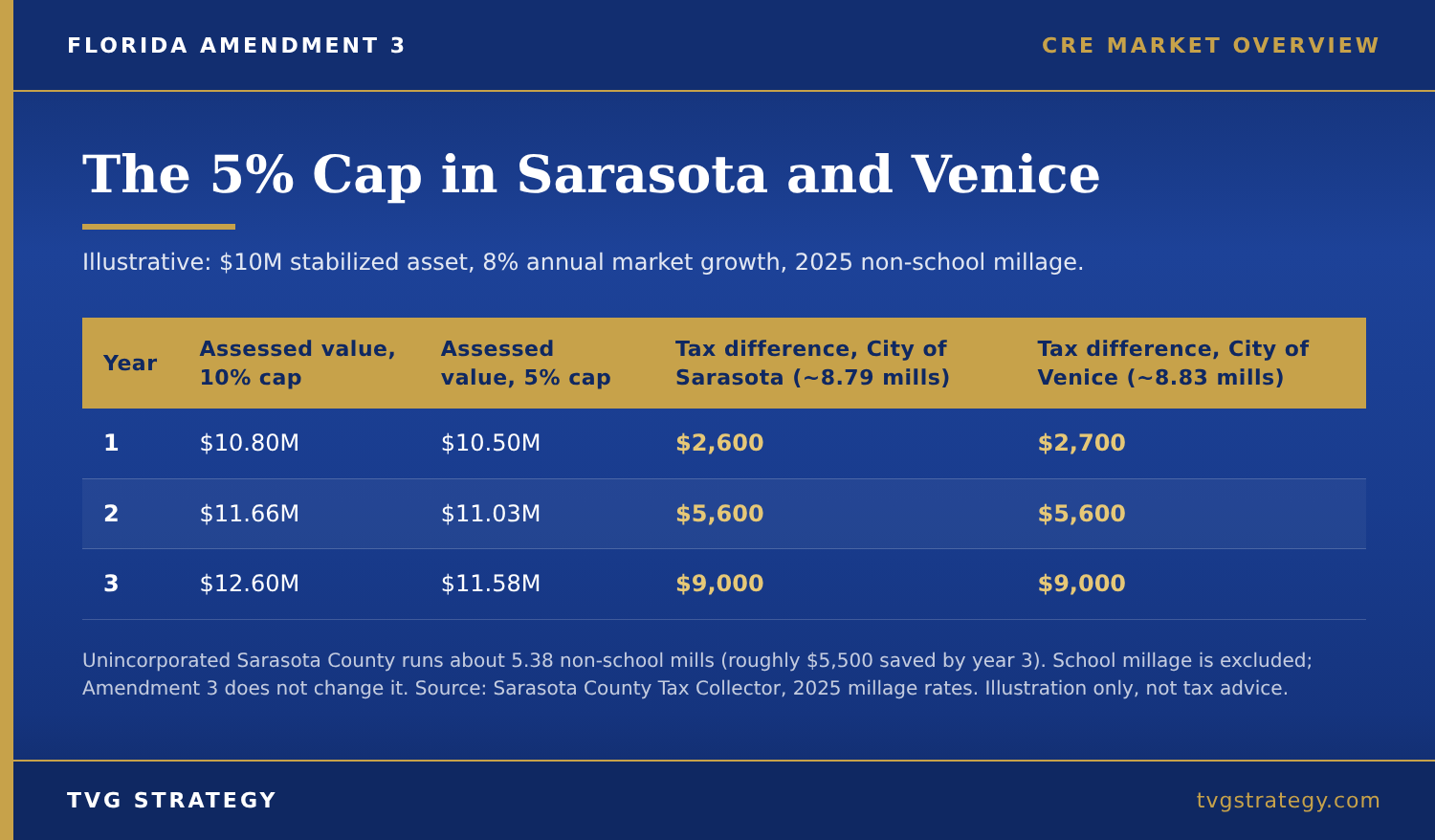
Illustrative tax savings from the 5% cap in the City of Sarasota and the City of Venice.
The two cities land almost in the same place: Venice’s higher city rate roughly offsets the EMS levy it doesn’t pay. Unincorporated Sarasota County runs lower, at about 5.38 non-school mills, so the same asset there would save roughly $5,500 by year 3. School millage (6.095) is excluded because Amendment 3 doesn’t change it.
The benefit belongs to the holder, not the asset. The amendment keeps Florida’s rule that non-homestead property is reassessed to full market value after a change of ownership or control (Kaufman Rossin). In the example, a buyer in year 3 would be reassessed at market value, about $1 million above the seller’s capped assessment. That shifts the economics in three ways:
• Long-hold owners accumulate a widening gap between assessed and market value.
• Buyers face a larger reassessment at acquisition, which belongs in every pro forma.
• Sellers gain a reason to hold, which could thin transaction volume in strong markets.
Homesteads have a release valve here: since 2008, portability has let owners carry their Save Our Homes savings to a new Florida homestead, which substantially eased lock-in for homeowners. Non-homestead property has no equivalent, so a commercial owner’s capped value ends at sale.
Millage is the uncapped variable. State analysts estimate the amendment would eventually reduce recurring local property-tax revenue by nearly $12 billion a year (Local10). The Florida Policy Institute warns localities may turn to rental and commercial properties to make up the difference (Newsweek). The Florida Chamber notes non-homestead property already pays 65% of property taxes collected (Keys Weekly). Scale makes small moves expensive: a 1% tax increase on a $15 million property adds $150,000 to the bill (WLRN).
Supporters see it differently. Governor DeSantis has argued the lower cap protects commercial owners and disputed that landlords would need to raise rents (CBS12).
What to do in underwriting now:
1. Run a millage sensitivity case, not just a single tax line.
2. Separate school and non-school millage; only the non-school portion is affected.
3. Model the reassessment at acquisition, including transfers into an entity.
4. Track non-ad valorem charges such as stormwater fees and special assessments, which the amendment does not limit.
Perspective 3: Commercial users
Commercial users are the businesses that occupy space: the dental practice, the distributor, the restaurant, the regional office. They are the audience most likely to absorb a cost shift, and the least likely to see it coming, because it arrives through the lease rather than a tax bill.
Lease structure decides who pays.
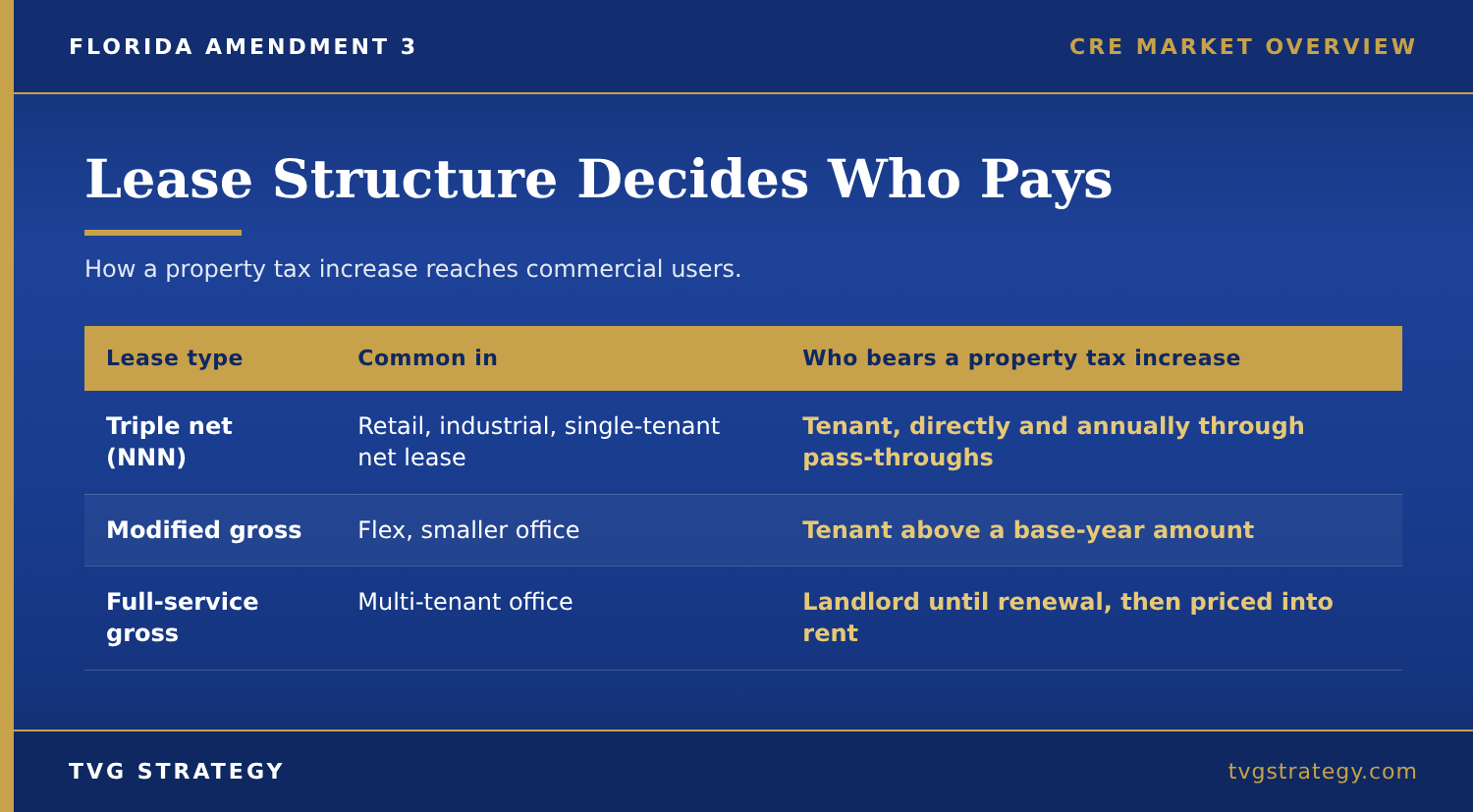
Table showing who bears a property tax increase by lease type.
If non-homestead taxes rise, the Florida Policy Institute expects businesses to decide whether to absorb the cost or pass it to customers (Newsweek). For a NNN tenant, that decision happens the first year tax pass-throughs reconcile.
Owner-users face both sides. A business that owns its building gets the 5% cap protection, as long as it holds. It also carries the millage risk directly.
Practical steps for users:
• Pull current leases and confirm how taxes and CAM are passed through, including any caps on controllable expenses (taxes are usually excluded).
• In 2027 renewals or new leases, negotiate base-year resets or tax-increase caps where leverage allows.
• For own-versus-lease decisions, add a property tax scenario to the analysis rather than holding taxes flat.
• Budget for fee-based costs that apply to every business regardless of lease, such as user fees and special assessments.
The system view: where the three perspectives meet
The three perspectives are not separate stories. They are one system, connected by a single uncapped variable: how local governments respond to the revenue gap.
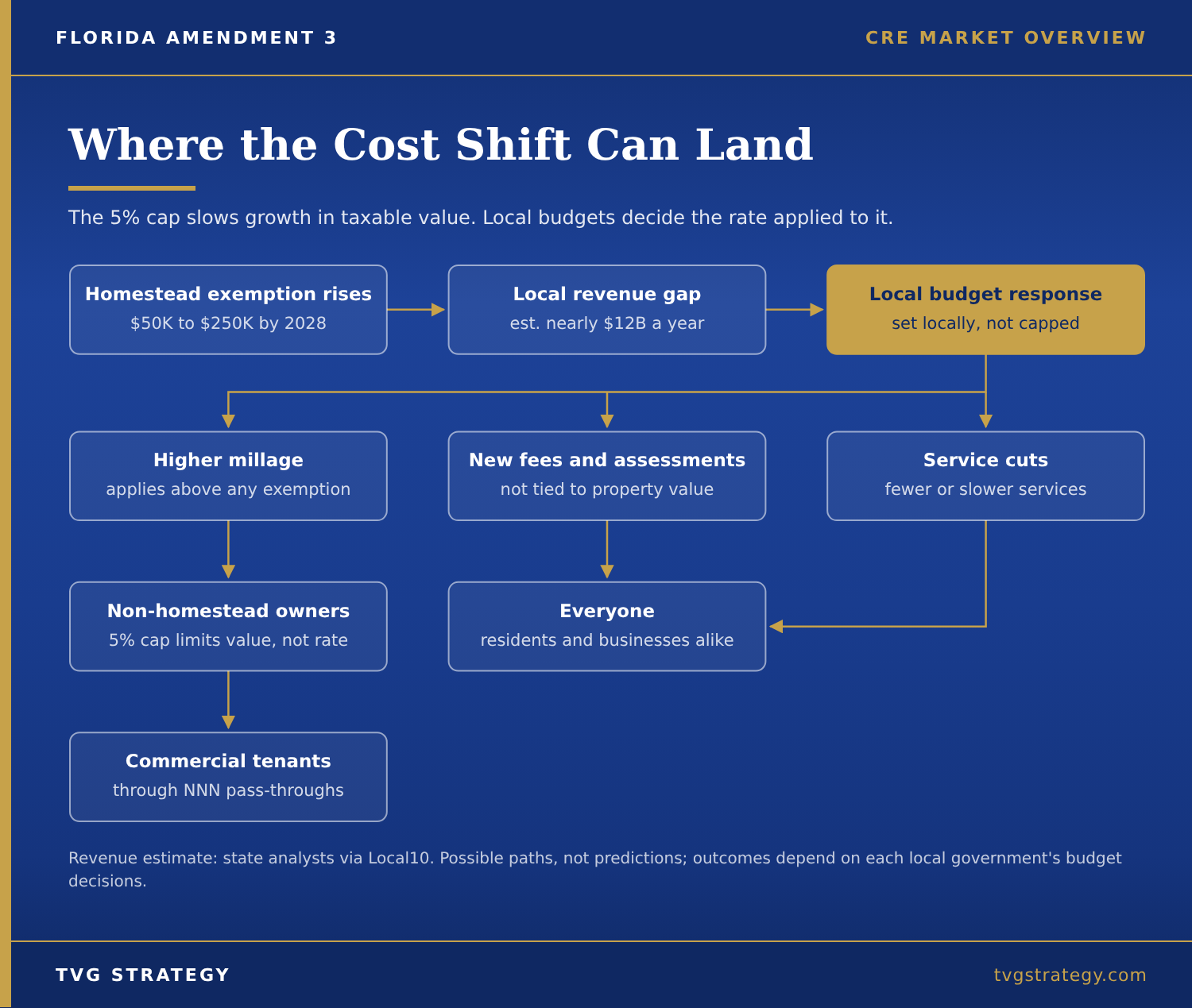
Flowchart showing how a larger homestead exemption can shift costs through local budget responses.
The homestead exemption creates the gap. Local budgets decide where it lands. Millage increases fall hardest on non-homestead owners and, through leases, on their tenants. Fees and service cuts reach everyone, homesteaded or not. The 5% cap slows growth in taxable value, but it does nothing to the rate applied to that value.
The amendment also directs the Legislature to set procedures for local governments to fully eliminate homestead property taxes (Keys Weekly). That signals the direction of travel, not just this one step.
What to watch if it passes:
• 2027 and 2028 budget and millage hearings in Hillsborough, Pinellas, Manatee and Sarasota counties
• New or expanded non-ad valorem fees and special assessments
• Implementing legislation from the 2027 session
• Lease renewal terms on tax pass-throughs and base years
Read the system, then decide
Amendment 3 is a values decision for voters, and reasonable people will land in different places. My aim here is narrower: make sure the decision is made with the whole system in view.
Whatever happens on November 3, the work is the same. Read the system. Build the evidence with real numbers for your property, your lease or your portfolio. Then lead the decision rather than react to it in 2027.
———
If you’d like to run those numbers for your property or portfolio, the conversation starts at tvgstrategy.com/engage.
———
My thanks to Cristin Madden, MBA, CCIM, for reviewing this analysis and sharpening it with her feedback. Any errors that remain are mine.
This post is for general information and is not legal, tax or investment advice. Consult your tax advisor or property appraiser about your specific situation.
Sources
• Kaufman Rossin: Florida Amendment 3, what individuals, businesses and investors need to know
• Local10: Florida releases court-ordered rewrite of Amendment 3 ballot language
• WLRN: Florida’s proposed property tax amendment will require trade-offs
• Newsweek: Winners and losers under Florida’s property tax overhaul
• Keys Weekly: Florida AG submits revised ballot language
• CBS12: DeSantis defends Amendment 3 amid local government concerns
• Hillsborough County Tax Collector: What Amendment 3 means for your property taxes
• Manatee County Property Appraiser: Proposed property tax amendment, HJR 1F
• Sarasota County Tax Collector: 2025 ad valorem millage rates