The Product Lifecycle Is a Brand Lifecycle. Most Organizations Build It Too Late.
A case for a new kind of life science leader, who sees commercialization not as a launch event, but as a strategic discipline integrated from the earliest stage of development.
That distinction — approved versus commercially viable — is the fault line that separates average drug development organizations from exceptional ones. Regulatory approval is a milestone. Commercial viability is a design problem. And like all design problems, it requires the right kind of thinking, applied far earlier than most organizations begin.
The framework that follows was built from the inside of the commercial process — across nineteen product launches in specialty pharma, medical devices, diagnostics, biologics, and neuromodulation, spanning two decades of field and leadership roles in life sciences commercialization. It is not a consulting model or a service offering. It is a synthesis of what works, observed across the full arc of development from preclinical through approval, and applied repeatedly in the field.
Life science product development is one of the most complex innovation processes in the world. It spans a decade or more, costs hundreds of millions of dollars, and ultimately exists to make a measurable difference in the lives of patients who have run out of other options.
Yet the dominant mental model in most organizations treats commercialization as something that happens after the science is done. Brand development begins at launch. Patient insight arrives late. Commercial strategy gets layered onto a molecule that was developed without it.
This post argues for a different model, and a different kind of leader — one who understands that every stage of the product lifecycle is also a brand-building moment, a patient insight opportunity, and a commercial readiness lever. One who brings human-centered thinking to a domain that has traditionally been governed by scientific and regulatory logic alone.
The leader this industry needs is not a scientist who learned marketing, or a marketer who learned science. It is someone who has operated inside the system at enough depth to know where the leverage is, and early enough to use it.
The Design Thinking Foundation: Why Double Diamond+ Applies to Drug Development
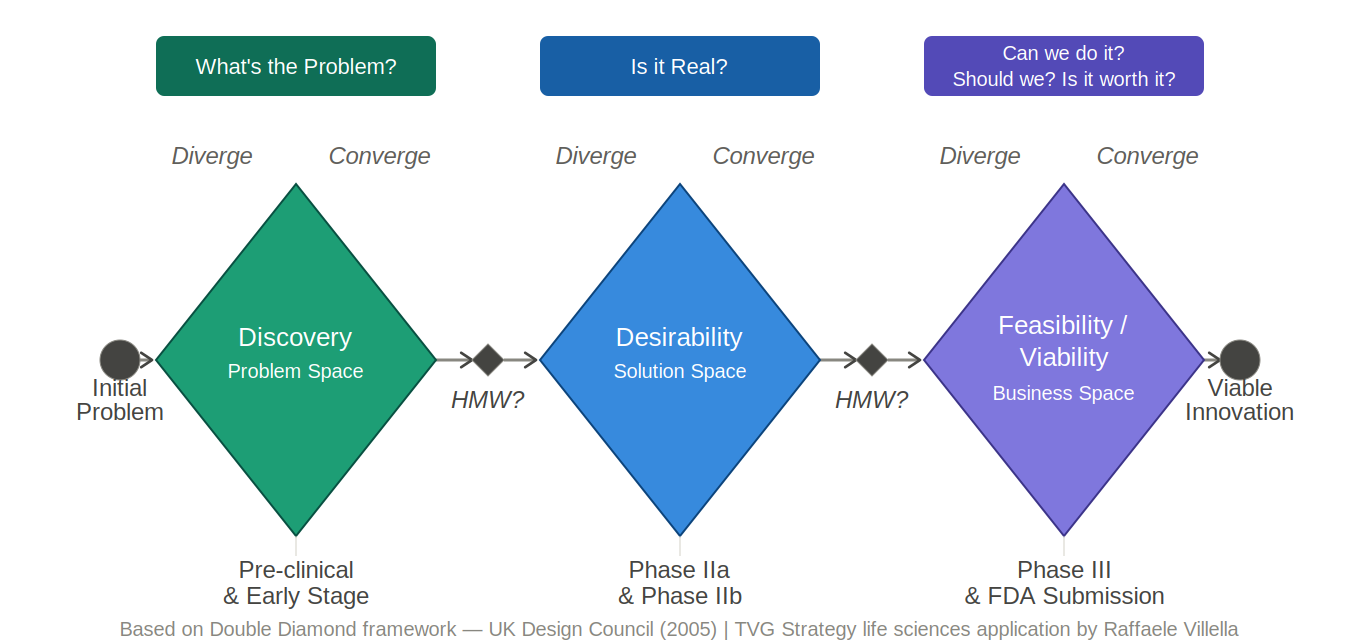
The Double Diamond+ framework — Discovery (Problem Space), Desirability (Solution Space), and Feasibility/Viability (Business Space) — applied as the organizing design logic for life sciences commercialization from pre-clinical development through FDA submission. Based on the UK Design Council Double Diamond framework (2005). TVG Strategy application: Raffaele Villella, Boston University Questrom School of Business MBA, 2026.
The failure mode this post addresses — commercialization treated as a launch event rather than a development discipline — is fundamentally a design thinking failure. It is what happens when an organization applies linear execution logic to a problem that is, at its core, an iterative design challenge.
The Double Diamond+ framework, developed from human-centered design thinking principles, provides the organizing logic for understanding why commercial interventions must be sequenced across the full development lifecycle — not concentrated at launch. It moves through three diamonds in sequence:
Diamond 1: Discovery — The Problem Space | What's the Problem?
Divergent thinking surfaces the full landscape of unmet need — patient experience, physician reality, payer logic, competitive context. Convergent thinking defines the problem precisely: the specific gap the product must fill, in the specific population that will benefit, against the specific alternatives that already exist. This is the work of Pre-Clinical and Early Stage development. It produces the Target Product Profile, the medical narrative, and the advocacy infrastructure. Most organizations skip this diamond entirely and proceed directly to solution.
Diamond 2: Desirability — The Solution Space | Is It Real?
Divergent thinking generates the range of possible solutions — trial designs, brand positions, KOL engagement strategies, value propositions. Convergent thinking tests those solutions against the real-world stakeholders who will determine the product's reception: investigators, specialist physicians, patient communities, and payers. This is the work of Phase IIa and IIb. It produces KOL relationships, advisory board intelligence, publication strategy, and a value proposition the market will actually respond to. The design thinking tool used at the transition between diamonds — 'How Might We' — is the right question at every phase gate: How Might We design a trial that generates evidence the payer will accept? How Might We build brand recognition with prescribers before the product has a commercial name?
Diamond 3: Feasibility/Viability — The Business Space | Can we do it? Should we do it? Is it worth doing?
Divergent thinking generates the hypotheses that must be tested: what label can we earn, what economic argument can we make, what evidence architecture will survive regulatory and payer scrutiny? Convergent thinking runs the experiments — Phase III trials, health economics modeling, publication sequencing — that produce the answers. This is the most expensive work in drug development, and it is only worth doing if the first two diamonds were completed with rigor. A product that enters Phase III without a well-defined problem space and tested solution is running the most expensive experiment possible on the most uncertain foundation available.
The Double Diamond+ makes explicit what the best life science commercialization leaders have always practiced intuitively: that drug development is not a linear process moving from science to market, but an iterative design process that requires divergent exploration and convergent definition at every major transition point. The commercial design framework that follows maps those transitions onto the specific interventions that determine whether a product reaches patients as a commercially viable solution or as a scientific achievement the market was never prepared to receive.
Drug development is not a linear process moving from science to market. It is an iterative design process that requires divergent exploration and convergent definition at every major transition point.
The Commercial Design Framework: Commercialization Levers Across the Full Lifecycle
What follows is not a theoretical framework. It is a map of concrete, sequenced interventions — spanning brand strategy, medical affairs, clinical development, and market access — that determine whether a drug reaches patients as a commercially viable product or as a scientific achievement the market never fully adopted.
Two functions operate across the entire lifecycle, independent of any single phase:
Lifecycle-Wide: Advocacy Relations and Digital Intelligence
Advocacy Relations is not a communications tactic. It is a trust infrastructure — built over years with patient communities, professional societies, government bodies, and payer networks — that a product draws on at every critical moment of its development. Organizations that begin this work late find themselves trying to borrow credibility they never built.
Digital and Social Media Analytics is the continuous intelligence layer across the development lifecycle. Long before prescribers are engaged or patients are recruited, this function identifies unmet needs, monitors disease community sentiment, tracks competitive positioning, and surfaces the human signals that shape everything from trial design to brand messaging. It can directly influence disease awareness, screening rates, prescription fulfillment, and treatment adherence. Its value is not in the data — it is in the decisions the data makes possible.
PRE-CLINICAL · STAGE A — Before the First Human Trial
◆ Diamond 1: Discovery Problem Space — What's the Problem? | Divergent thinking: surface the full unmet need landscape
Most organizations do not think about brand during preclinical development. The ones that do arrive at Phase II with advantages their competitors spend years trying to recover. This is where the problem space is defined — the patient whose life the product must change, the physician whose practice it must fit, the payer whose logic it must satisfy.
Non-Proprietary Naming
After an Investigational New Drug (IND) exemption is filed, a submission goes to the United States Adopted Names (USAN) Council to establish the drug's generic name — a process that can take up to two years. This name will appear in every clinical study, become the default reference among healthcare providers, and begin accumulating scientific credibility before any commercial brand exists. Organizations that treat this as a compliance step miss the opportunity to begin building brand equity from the earliest possible moment. It is inexpensive. It is mandatory. And it is a brand decision.
Clinical Trial Branding
A named, branded trial program is not a marketing exercise — it is an organizational alignment tool and a patient recruitment asset. Thoughtfully designed trial branding generates early engagement among investigators, Key Opinion Leaders, patients, and future prescribers. It produces the first tangible artifacts of the product's identity: site packets, KOL presentations, trial communication pieces, and journal advertisements. These are not launch assets. They are the foundation on which launch assets are built.
Brand Name Development
Commercial brand name development balances creative market resonance against regulatory viability, and the FDA scrutinizes proposed names carefully for confusion potential with existing products. A rejected brand name can delay a product launch by months, with revenue consequences measured in the tens of millions. Beginning this work during Phase 2b — as early as possible — is not a marketing preference. It is a risk management decision, and one that builds patient and provider trust long before approval.
EARLY STAGE · STAGE B — Confirming Viability Before Sinking Cost
◆ Diamond 1: Discovery → Diamond 2: Desirability Convergent thinking: define the problem precisely | Divergent thinking: begin generating solutions | HMW — How Might We design a trial that generates evidence the market will actually respond to?
Early stage is where commercial and clinical strategy must begin to operate as one. The decisions made here — about what to study, in whom, against what comparator — will define the product's commercial ceiling years before launch. The convergent work of Diamond 1 produces the precise problem definition. Diamond 2 begins: what does a solution that satisfies patients, physicians, and payers actually look like?
Target Product Profile Assessment
The Target Product Profile is a product forecast and a strategic filter. It outlines expected efficacy, safety, tolerability, and indications from the perspective of patients, providers, and payers — and it informs the ultimate go/no-go decision before the organization commits the full cost of clinical development. This is human-centered thinking applied to drug development: building the product around the needs of the people who will use and pay for it, not solely around what the molecule can achieve in isolation. Initiated before Phase II, it is one of the most consequential documents a development organization produces.
Phase II Planning
The clinical team maps the studies that will move the program from healthy volunteers into actual patients. The design choices made here — endpoints, patient populations, comparators, geographies — have direct commercial consequences that will not be visible for years. Integrating commercial intelligence into Phase II planning is one of the highest-leverage interventions available to a life science organization.
PHASE IIa · STAGE C — The First Human Face of the Organization
◆ Diamond 2: Desirability Solution Space — Is It Real? | Divergent thinking: ideate, prototype stakeholder engagement strategies
Phase IIa is the moment the organization steps into the external scientific world for the first time. In design thinking terms, this is the ideation and prototyping stage of Diamond 2 — testing whether the solution the organization has conceived is one the market's most influential voices will recognize as real and valuable. The impressions formed with academic researchers, specialist physicians, and institutional thought leaders are durable. First-mover advantage in stakeholder relationships is real, and it compounds.
Strategic Design of Field Medical Teams
The Medical Science Liaison function is the first human connection between the organization and the scientific community. These are not sales representatives — they are scientific communicators engaging the highest tier of clinical thought leadership: academic medical centers, specialty societies, and investigator networks. The design of this team — territory structure, therapeutic area alignment, training architecture, and performance framework — must be initiated before Phase II begins. A poorly designed deployment creates misaligned stakeholder relationships that persist through launch and beyond.
Medical Narrative Development
The medical narrative is the evidentiary story that answers a foundational question: why should a researcher, a regulator, a payer, or a patient believe this product will matter? It synthesizes mechanism of action, preclinical data, unmet need, and competitive context into a coherent scientific argument. This narrative must be established before Phase II enrollment begins. It is not a document — it is the backbone of publications, regulatory submissions, health economics arguments, and ultimately, prescriber communications. It defines what success looks like before success is achieved.
Phase III Planning
While Phase IIa is underway, the clinical team is simultaneously designing the pivotal trials that will generate the evidence base for FDA approval. These are large-scale, randomized, multi-center studies — the most expensive and consequential work in drug development. The commercial decisions embedded in their design will determine the product's label, and the label will determine the product's commercial life.
PHASE IIb · STAGE D — Central Command for Commercial Viability
◆ Diamond 2: Desirability → Diamond 3: Feasibility/Viability Convergent thinking: test and validate the solution | HMW — How Might We position a product that earns payer support before approval? | Transition to Business Space: can we do it? Should we do it? Is it worth doing?
Phase IIb is the most commercially intensive stage of drug development before launch. Every lever activated here compounds forward. Every lever missed creates a debt the organization will pay at launch — or never fully recover from. In Double Diamond+ terms, this is both the convergent phase of Diamond 2 — testing whether the solution is real — and the divergent opening of Diamond 3: generating the hypotheses that Phase III must validate.
Clinical Trial Branding — Expanded
By Phase IIb, trial branding takes on a new strategic dimension. A recognizable identity for the pivotal trial program begins building brand recognition with prescribers before the product has a commercial name. Timing depends on market landscape and differentiation needs, but the principle is consistent: every patient touchpoint, every investigator communication, every KOL interaction is a brand moment — whether the organization intends it or not.
Brand Naming
The commercial brand name must balance creative resonance with regulatory viability, and the ideal window for executing this work is Phase IIb. Brand naming is not a creative exercise. It is a cross-functional strategic decision with legal, regulatory, and commercial dimensions that must be navigated with rigor and sufficient lead time.
KOL Identification and Engagement
Key Opinion Leaders are not recruited at launch. They are identified during the latter part of Phase II, when Phase III planning is underway, and cultivated through years of scientific exchange. The criteria for selection, the strategy for engagement, and the architecture of the speaker and advocacy programs that follow are all designed at this stage. Done well, this work creates the external credibility infrastructure that a product draws on for its entire commercial life.
Advisory Boards
Advisory boards are the structured feedback loop between the organization and the external stakeholders who will ultimately determine the product's reception. In Double Diamond+ terms, they are the testing mechanism of Diamond 2 — the structured way the organization learns whether its solution is desirable before committing the full cost of Diamond 3. The insights surfaced here should be inputs to development decisions — not retrospective validation of decisions already made.
Value Proposition Optimization
This is the gut check — the rigorous, multi-stakeholder assessment of whether the product, as it is emerging from trials, is actually commercially compelling. What defines value for this market? Should the program include a head-to-head study? Which comparators matter most to payers? What are the economic implications of different dosing regimens or pursued indications? What is the true cost of not treating this condition — in downstream hospitalizations, lost productivity, additional interventions? Value proposition optimization, initiated before Phase III, shapes the studies that generate the evidence the market will actually respond to.
Publication Planning
A publication plan is the strategic architecture for how a product's data enters the scientific record. Journal selection, timing, authorship, and topic sequencing determine the narrative and dissemination of information in ways that build — or erode — stakeholder confidence over time. Beginning this work during Phase 2b, aligned with Phase III planning, ensures that data availability and publication strategy move in concert from the start.
Scientific Platform Development
The scientific platform is the evidence-based master document from which all scientific communications derive. It ensures consistency and accuracy across every channel — publications, medical education, regulatory submissions, payer dossiers, and field medical communications. It begins during Phase II trials and evolves as evidence accumulates. Its discipline is the discipline of the organization: it makes it structurally difficult for different functions to tell different stories about the same product.
Customer Perception and Benchmarking Research
Before Phase III begins, the organization needs a baseline: where does this drug, this company, and its engagement efforts stand in the competitive landscape? What do physicians, payers, and patients already believe — and what will it take to move those beliefs? This benchmark becomes the measuring stick against which medical affairs success is assessed through and beyond launch. Without it, progress feels like movement. With it, it can be measured.
PHASE III · STAGE E — The Evidence That Must Earn Its Market
◆ Diamond 3: Feasibility/Viability Business Space — Can we do it? Should we do it? Is it worth doing? | Convergent thinking: run the experiments, validate the hypotheses, earn the label
Phase III is not the beginning of commercialization. By the time pivotal trials are underway, the commercial foundation should already be established. The organization should know its narrative, its stakeholders, its value proposition, and its competitive positioning. Phase III is Diamond 3's convergent phase — the experiments are designed, the hypotheses are defined, and the work now is to generate the evidence that validates them under the most rigorous scientific standard in medicine.
FDA Submission
The submission of clinical evidence to the FDA for approval is the culmination of years of scientific, regulatory, and — if the preceding work was done well — commercial development. Approval is the milestone. Commercial viability is what was built along the way to earn it. In Double Diamond+ terms, it is the 'Viable Innovation' that emerges at the end of the third diamond — not just a product that works scientifically, but a solution the market was designed to receive.
The Leader This Work Requires
The commercial design framework described here is not a marketing strategy. It is a systems view of how brand, science, medicine, market access, and patient insight interact across a decade of development — and how the decisions made at each stage compound into the commercial outcome at launch.
Leading inside this system requires a specific kind of intelligence. Scientific expertise alone underestimates the commercial consequences of clinical design choices. Commercial expertise alone — arriving at launch without understanding what was built before — cannot leverage it. Operational excellence without strategic coherence produces activity, not momentum.
The Double Diamond+ framework makes explicit what this kind of leadership actually requires: the ability to hold divergent and convergent thinking simultaneously across an extended timeline. To explore broadly at every phase transition — what does the patient actually need, what will the payer actually accept, what will the prescriber actually change? — and then to converge precisely on the decisions that compound forward.
The right organizing principle is one that keeps the human at the center of every development decision — patient, physician, and payer — across a timeline that spans phases, not quarters. That question — who are we building this for, what do they actually need, and how do we know? — surfaces the patient insight that should shape trial design, the physician reality that should shape the medical narrative, and the payer logic that should shape the value proposition, all years before launch.
The most expensive mistake in life science commercialization is not a failed trial. It is an approved product that the market was never prepared to receive.
The leader who prevents that mistake is not defined by a single function. They have operated across enough of this system — brand strategy, medical affairs, clinical development, market access, field operations — to see how the levers connect. They think in timelines that span phases, not quarters. They understand that every touchpoint with a patient, a physician, or a payer is a brand moment, whether the organization intended it or not. And they apply the design discipline of divergent exploration and convergent definition at every critical transition — before the cost of getting it wrong becomes irreversible.
That leader is not common in life sciences. Building the case that they are necessary — and demonstrating what they look like in practice — is the work this industry needs done.
The goal is not to launch an approved product. The goal is to launch a product the market was built to receive — and the discipline that produces that outcome begins not at launch, but at the earliest moment the problem space can be defined.